
Whether you are building a woven wire deer fence to protect livestock, exotics, or special equipment from predators, few solutions match the durability and longevity of an 8-foot high game fence built with 12-foot treated round posts and high-tensile fixed-knot wire. Manufactured to provide the strength, containment, and pressure resistance, this type of fence is considered the gold standard for ranches, hunting properties, and wildlife enclosures across the country.
In this guide, we will discuss the complete guideline of building game fences, also known as “deer fence” or “high fence”.
Why Choose an 8-Foot Game Fence?
An 8’ fence is the perfect balance between visibility and containment, especially for animals that are capable of jumping, testing boundaries, or pushing at weak spots. Some benefits of 8ft height includes preventing deer and exotics from clearing the fence, creating controlled breeding environments, keeping predators out like coyotes or other unwanted wildlife, and optionally add-top line electric for added security.
The added height also distributes vertical tension more evenly, helping prevent sagging over time.
Rutgers University describes further why exclusion fencing is needed and more important details when building your next deer fence in the article, High-Tensile Woven Wire Fences for Reducing Wildlife Damage.
Picking the Right Posts: 12-Foot Treated Round Posts
Treated round posts are the backbone of your fence – nothing beats 12-foot treated round posts for long-term reliability. Without strong posts with proper length, the fence can become unstable or not be able to handle high pressure.12-foot fence posts are the standard because they give you the depth and leverage needed to hold tension. Sometimes depending on certain factors, fence builders may opt for a 14-foot post.
When building a 8’ fence, opt for a 4” diameter or 5” diameter x 12’ post for the line posts treated with CCA. Bracing, corners, gates, should most likely be built with a 6” diameter post, with 5” being an option in select circumstances. CCA treatment will provide the longest lifespan of a post, with an average of 30-50 years.
Post spacing plays a major role in the strength and longevity of a fence, and while it can vary depending on terrain and wildlife pressure, the most common spacing in our region is 15–20 feet between line posts. In lighter pressure areas, you can stretch that out to around 20–25 feet without issues. However, for deer, exotics, and general high-tension situations, sticking to the 15–20 foot range is the safer choice. In areas with heavy pressure — especially hog country, hills, curves, or places where animals are more likely to test the fence — spacing should be tightened to 15 feet or less for maximum support and stability.
One simple rule to always follow: The heavier the pressure, the closer the posts.
Post depth also plays a crucial part in the stability of the fence. Typically, the post should be 4-feet into the ground.
Fixed-Knot vs. Field Fence for Woven Wire Deer Fence
There is a debate between which type of wire is best suited for an 8’ high fence, but it usually ends the second someone tightens both wires and watches what happens. Field fence will sag, while the fixed-knot does not want to.
Field fence has a medium tensile strength while fixed-knot has a high tensile strength. This means that a fixed-knot fence can handle high pressure over time. Each joint is locked with a fixed knot — meaning animals can push, lean, test, rub — and the fence holds its shape.
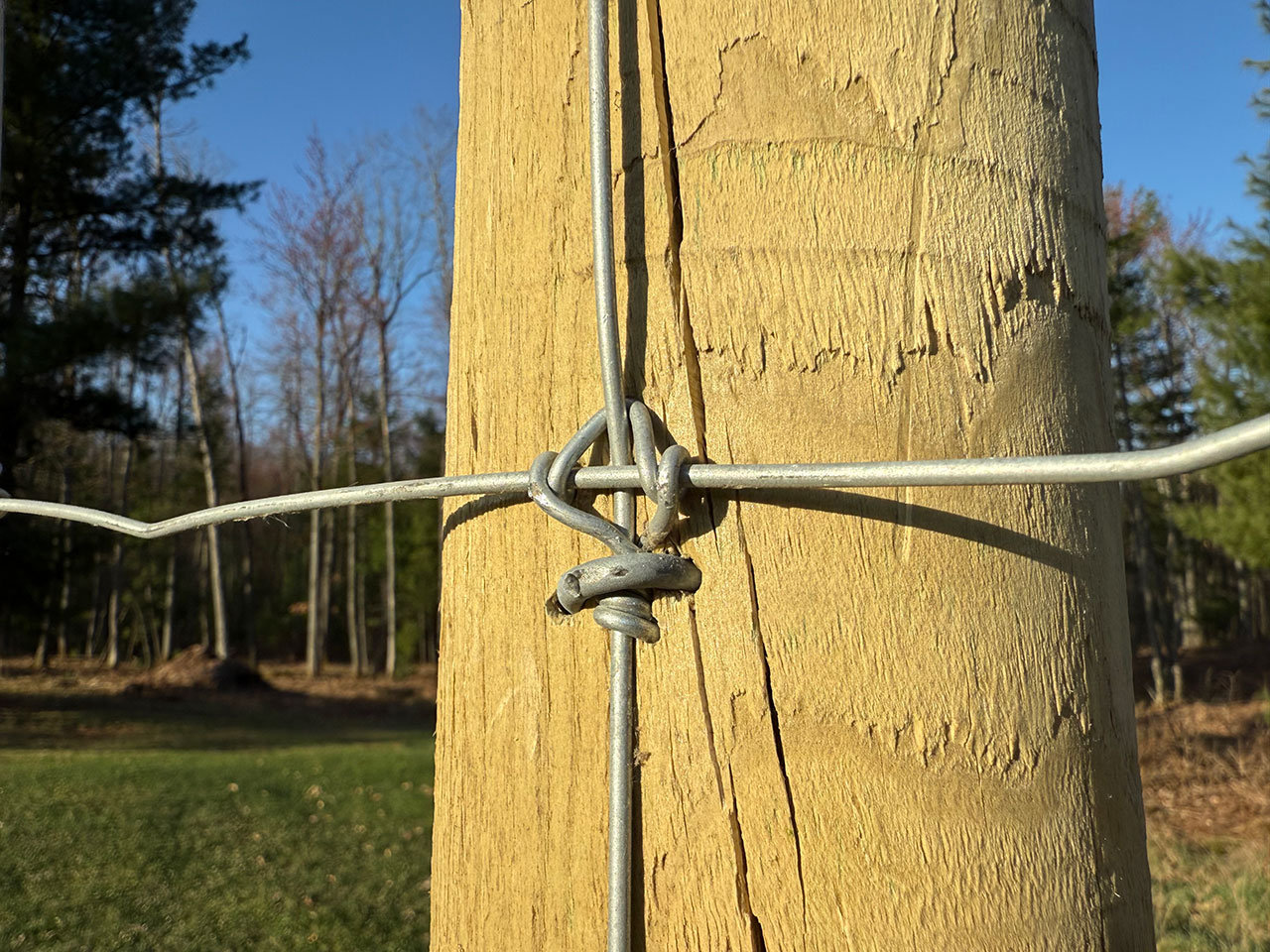
High-Tensile 20/96/6 12.5ga Wire vs. 20/96/12 12.5ga Wire
We recommend using a high-tensile fixed-knot woven wire, such as 2096-6 12.5ga or 2096-12 12.5ga for your game fence. Both provide great security, however there are some differences between the two.
When choosing between 20/96/6 12.5ga and 20/96/12 12.5ga high-tensile game fence wire, the biggest difference comes down to the spacing between vertical stays and how that affects the fence’s purpose. 20/96/6 features 6-inch stay spacing, meaning the vertical wires are closer together, creating a tighter mesh pattern. This makes it ideal for areas with higher wildlife pressure, especially where hogs, exotics, small deer, or predators are present, because the smaller openings reduce the chance of animals pushing through, squeezing under, or deforming the wire. On the other hand, 20/96/12 uses wider 12-inch stay spacing, which still offers great strength but with larger gaps between vertical strands. This style is often used for large acreage perimeter fencing where pressure is moderate, or where the priority is containing mature deer and livestock rather than stopping hogs or smaller animals.
At West Branch Wood Treating Sales, we deliver high-quality 20/96/6 and 20/96/12 deer fence wire, sourced directly from Bekart.
Final Word
If you want a fence that holds deer, exotics, livestock, and predators where they belong — an 8-ft game fence with 12-ft treated posts and fixed-knot 2096 wire is the industry standard for a reason. It’s strong, long-lasting, low-maintenance, ideal for large wildlife properties and will last for decades.
Looking for More Information on Our Products?
Reach Out and Experience the Difference
with West Branch Wood Treating Sales.
Contact us today for a free estimate or any additional inquiries.